

How to Care for Natural Stone Countertops (Quartzite, Marble & Granite)
A North Shore Chicago Designer’s Guide to Care, Cleaning and Sealing
So you fell in love with a quartzite slab, or maybe a beautiful piece of marble, and now it’s installed and gorgeous in your kitchen. Congratulations! Natural stone is one of the most stunning choices you can make, whether your kitchen is on the North Shore or out in the Northwest Suburbs. But now comes the question we hear on nearly every project once the dust settles: “How do I take care of this thing?”
It’s a fair question, and the honest answer is that natural stone isn’t difficult to care for, but it does ask a little something of you. The good news is that “a little something” really is little, once you know the handful of rules that matter. Most of the countertop heartbreak we see, (etching, dull spots, mystery stains) comes down to a few avoidable mistakes.
Here’s everything our clients across Highland Park, Winnetka, Barrington, Arlington Heights, and the rest of the North Shore and Northwest Suburbs need to know to keep their natural stone looking as beautiful in year ten as it did on install day.
First, Understand What You’re Working With
Natural stone, whether it’s quartzite, marble or granite – is porous. That’s the single most important thing to understand. Unlike engineered quartz, which is non-porous and sealed by its very nature, natural stone has microscopic openings that can absorb liquids if they’re given the chance. That’s not a flaw. It’s simply the nature of a material that formed in the earth.
This is why natural stone gets sealed, and why that seal matters so much. The sealer is a protective barrier that buys you time, so a spill sits on top of the surface long enough for you to wipe it away instead of soaking in and staining. Understand the seal, respect the porosity, and the rest of this guide falls into place.
One more distinction worth knowing… staining and etching are two different problems. A stain is a discoloration from a liquid soaking into the stone. Etching is a chemical reaction where an acid actually eats into the surface and leaves a dull, rough spot, even on a perfectly sealed counter. Sealing helps a lot with staining. It does not fully prevent etching on acid-sensitive stones like marble. Knowing the difference helps you understand why the rules below exist.
The Daily Rules – Keep It Simple
Day-to-day care is genuinely easy. For routine cleaning, all you need is warm water, a few drops of mild dish soap, and a soft cloth or microfiber towel. Wipe, rinse, dry. That’s it. You don’t need a cabinet full of specialty products to keep stone clean on a daily basis.
A few simple habits make all the difference:
- Wipe up spills promptly, especially anything acidic or deeply colored, like wine, coffee, citrus juice, or tomato sauce. The seal gives you time, but it’s not an invitation to leave a puddle of red wine overnight.
- Use a microfiber cloth, not a scouring pad. Soft tools clean just as well without risking micro-scratches.
- Use coasters under glasses and trivets under anything hot. (More on heat below… it matters more than people think.)
- Don’t use the counter as a cutting board. Quartzite is hard enough to dull your knives before it scratches, but it’s still better for everyone involved to use a cutting board.
That’s the entire daily routine. Where people get into trouble isn’t the cleaning itself, it’s what they clean with.
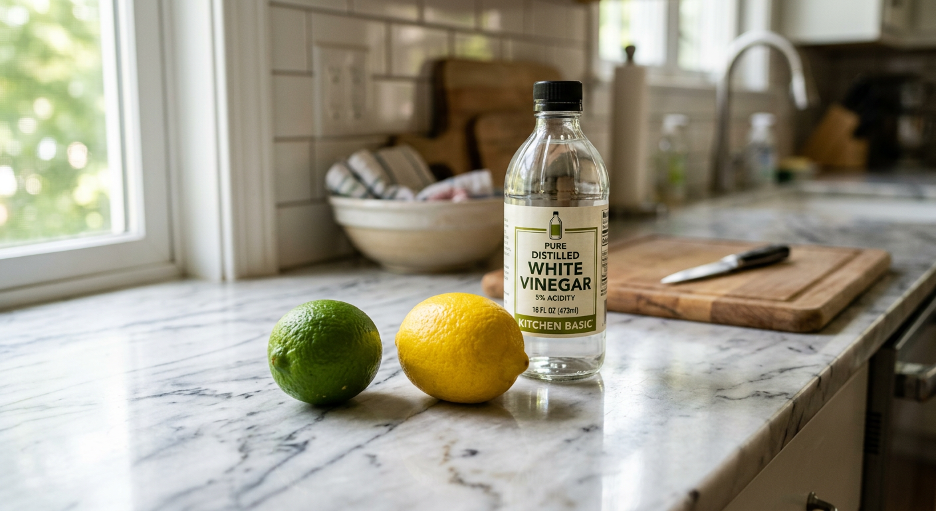
The “Never” List – What Actually Ruins Stone
This is the part I wish every homeowner heard before they stocked their cleaning cabinet, because most of the damage we see traces back to one of these. Keep these away from your natural stone:
- Vinegar, lemon, and lime. They feel “natural” and safe, which is exactly why they catch people off guard. They’re acidic, and they both etch the stone and break down your sealer over time.
- Bleach and ammonia. Harsh, and they degrade the seal and can cloud or discolor a polished finish.
- Glass cleaners like Windex with ammonia. These strip the protective barrier, leaving the stone exposed and vulnerable to stains.
- Abrasive powders and scouring pads. Think Comet, steel wool, green scrubby pads. They create microscopic scratches that dull a polished surface over time.
- Generic “all-purpose” sprays. Many contain acids or harsh chemicals that aren’t stone-safe, even when the label doesn’t make that obvious.
Here’s the takeaway that ties it all together… if it isn’t pH-neutral and labeled safe for natural stone, keep it off your counter.When in doubt, plain soap and water is always safe. And notice the through-line: nearly everything on this list doesn’t just risk the stone itself, it strips the sealer you paid good money for. Which brings us to the part most homeowners have the most questions about.
Sealing: The Thing Everyone Has Questions About
If there’s one topic that generates more confusion than any other in a North Shore kitchen design, it’s sealing the countertop. Let’s clear it up.
About That “15-Year Sealer”
A lot of fabricators will tell you they’re applying a “15-year sealer” to your stone. Those premium long-life sealers are real and they’re good. But here’s the detail that doesn’t always make it into the conversation… that 15-year number assumes ideal care. It is not a set-it-and-forget-it guarantee.
Every single thing on the “Never” list above also shortens the life of your sealer. Acids eat it. Bleach and ammonia break it down. Glass cleaners strip it. Abrasive pads scratch through it. And even heat from a hot pan can degrade it over time. So read a 15-year warranty as “up to 15 years if you treat this stone with care.” Use a lemon-scented spray and a scrubby pad every day, and you’re stripping it far sooner than the label suggests. It’s not a knock on the product, it’s just the honest reality of how seals work.
How to Know When It’s Time to Reseal — The Water Test
Here’s the best part… you don’t have to guess, and you don’t have to call anyone. There’s a simple test you can do yourself, and it takes about 15 minutes.
It’s called the water test. Pour a small puddle of water, roughly three inches across, onto the stone and let it sit for 10 to 15 minutes. Then wipe it away and look closely:
- If the surface looks unchanged or the water beaded up, your seal is doing its job. You’re good.
- If the water soaked in and left a darker spot that lingers even after you’ve wiped it dry, that’s moisture penetrating the stone. It’s your signal that it’s time to reseal.
Test a few spots, especially around the sink and your busiest prep area, since those zones wear first. Simple, free, and it takes the guesswork completely out of the equation.
So How Often, Really?
You’ll hear “reseal every year” thrown around a lot. For some softer or more porous stones, that’s fair. But for a durable, properly sealed stone like quartzite or granite in a normal household, every three to five years is often more realistic. Let the water test be your guide, not the calendar. Your stone will tell you when it’s thirsty.
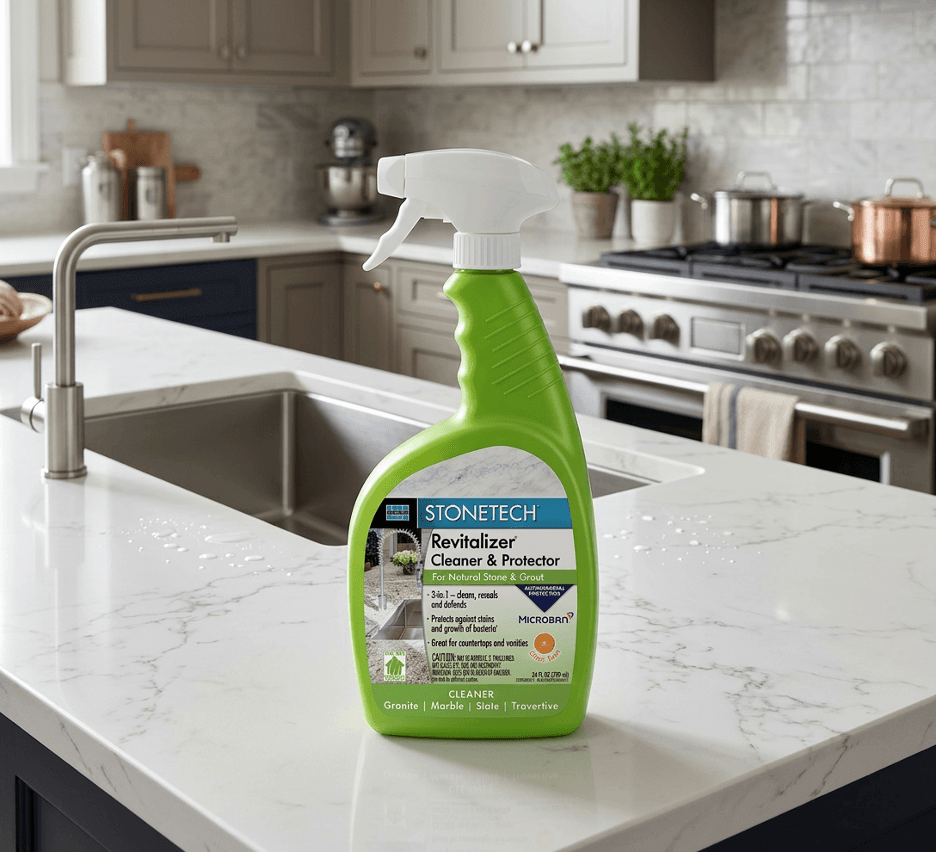
A Trick that Buys You More Time
Here’s a tip that makes the whole thing easier. You can swap your daily cleaner for one that maintains and refreshes the sealer while it cleans, instead of one that strips it. These “clean and protect” formulas reinforce the seal a little with every wipe-down, which extends the stretch between having to reseal. The one I’ve reached for is StoneTech Revitalizer Cleaner & Protector. It’s easy to find and easy to live with.
One honest caveat so you’re not caught off guard… these maintenance cleaners don’t replace sealing. You still want a proper sealer applied first (your fabricator handles this at install), and the protective cleaner extends its life from there.
Resealing: Leave It to a Professional
Don’t Forget About the Heat
People think of heat as a countertop’s enemy only in terms of cracking or scorching, but here on a stone-care guide it’s worth repeating for a second reason… heat degrades your sealer, too.
Natural stones like quartzite and granite handle heat far better than engineered quartz, since there’s no resin to soften. But “handles heat well” isn’t the same as “bulletproof.” The bigger risk with any stone is thermal shock, the stress created when a 500-degree pan hits a 70-degree countertop, all that temperature change concentrated in one small spot. That sudden stress can cause a crack, especially near seams and edges, even on a heat-tolerant stone.
So the rule is the same one I give every client: if a pan is hot, use a trivet. It protects the stone from cracking, and it protects your sealer from breaking down. A few-dollar trivet guarding a several-thousand-dollar countertop is worth it.
The Bottom Line
Caring for natural stone really comes down to a short list: clean with mild soap and water or a stone-safe cleaner, keep the acids and abrasives away, use trivets and coasters, run the water test every so often, and reseal when the stone tells you it’s time. Do those few things, and your countertop will reward you with decades of beauty.
Natural stone asks for a little respect, and it gives so much back. That’s the trade, and for the right homeowner, it’s an easy one to make.
That’s exactly the kind of guidance we bring to every kitchen design and remodel project across the North Shore and Northwest Suburbs, long after install day.

Thinking about a kitchen remodel on Chicago’s North Shore or in the Northwest Suburbs – Winnetka, Highland Park, Lake Forest, Glencoe, Wilmette, Barrington, Arlington Heights, Palatine, Crystal Lake, or anywhere nearby?
Reach out and let’s talk about your kitchen. Email me, call, or fill out the form below to get started.